
By: Arthur Roseberry
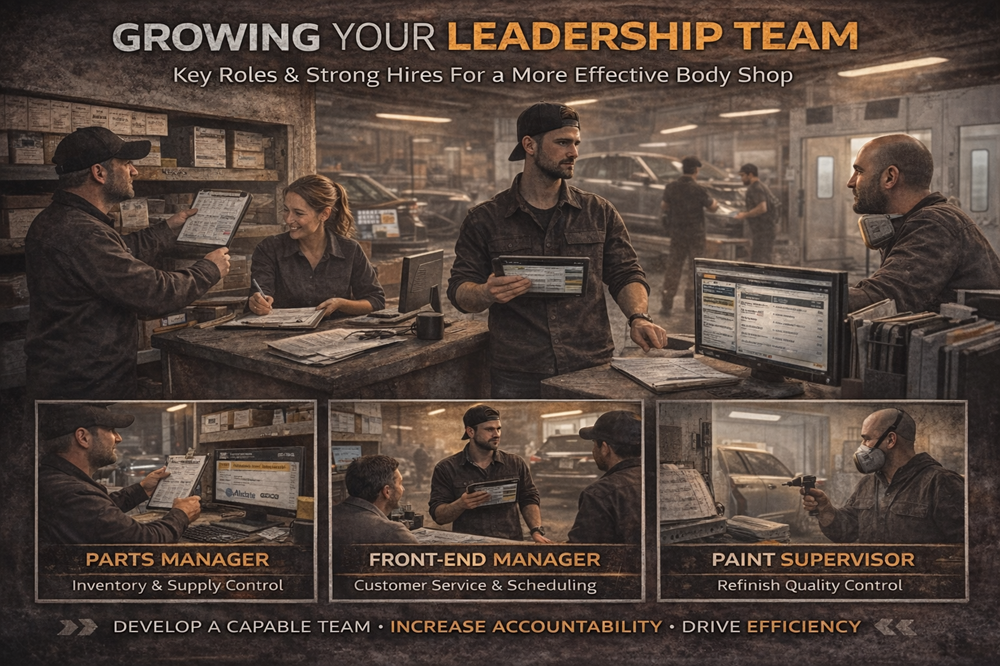
No shop can become its best on the strength of one leader alone.
No business achieves long-term success with a single person at the top. As operations expand, lower-level leaders and managers become just as critical as the owner. This is especially true in collision repair, where production, estimating, parts coordination, and customer communication all move independently and at the same time. Adding the right leadership roles and filling them with the right people is a necessary step in growing your shop. Strong leadership hires improve clarity, flexibility, and execution of the entire shop. Poor leadership, on the other hand, can create confusion, reduce morale, and introduce new inefficiencies.
Defining the position before you fill it.
Before promoting or hiring, clearly outline what the new leadership role will handle on a day-to-day basis. Without a defined scope, a manager quickly becomes either redundant or a source of overlap and tension. Authority and tasks must be clear before the new position is filled. In a body shop, common mid-level leadership roles may include a front office or customer relations manager, a production manager, a paint department lead, or a parts and inventory coordinator. The right structure depends entirely on your shop’s specific bottlenecks.
A practical way to identify the correct role is to examine where your time is consistently drained. Which responsibilities pull you away from long-term strategy? Which departments lack ownership or accountability? If a task is important but does not require your personal involvement every day, it may justify added support from new leadership.
Skills and style matter more than seniority.
Choosing the right individual is just as important as clearly defining the role. The experience of an employee with your shop alone does not qualify someone for leadership. A talented technician does not automatically become an effective production manager. A dependable front desk employee may not have the knowledge required to supervise the floor. Leadership positions require communication strength, organization, and the ability to make sound decisions under pressure. So it is critical to promote based on capability, not comfort.
If you select a newer or less senior employee, transparency is critical. Your team should understand why the decision was made. At the same time, long term employees must feel valued through recognition, non-leadership growth opportunities, or performance incentives. Poor communication during promotions is one of the fastest ways to damage morale and kneecap your new leader.
Redistributing work is not the same as adding efficiency.
Assigning someone to manage insurance documentation, customer updates, or parts coordination may remove those tasks from your plate, but it does not reduce the workload itself. Without improved systems, you are simply shifting the administrative burden from one person to another. To maximize the impact of new leadership roles, equip them with proper tools. Modern collision repair management software can streamline estimate to invoice workflows, centralize communication, organize documentation, and integrate payment and accounting systems.
When information is structured and accessible, leaders can focus on oversight and performance improvement instead of chasing paperwork. Expanding leadership should increase accountability and execution, not add cost without return. When clearly defined roles are paired with capable individuals and supported by strong systems, your leadership team becomes a multiplier for growth rather than an added expense.


Growth doesn’t break shops, unclear roles and rushed promotions do. Are owners building real leaders under them, or just handing out titles to plug gaps?