
As all businesses grow, the processes that once felt simple often become more layered, unruly, and complex.
For body shops and collision repair businesses, this natural progression can be seen at every stage of the repair cycle, from the first website inquiry to final vehicle delivery. Updating and refining procedures is necessary to handle increased volume and real-world challenges, but without intentional structure, those evolving processes can become overlapping, inefficient, and chaotic. When many daily tasks rely on informal habits built on reaction instead of clearly defined systems, small inefficiencies compound throughout the day, costing your shop money and disrupting the flow of your team.
When evaluating the organic, piecemeal procedures your team has developed, it is important to understand why they came about in the first place.
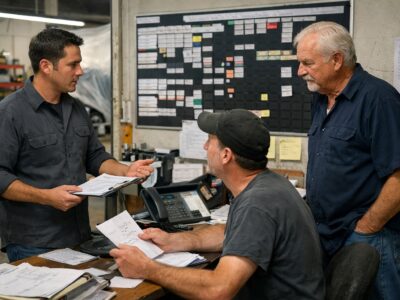
Most workarounds are created to solve a real problem. For example, customer contact information may be written directly on a repair order because staff need quick access and do not fully trust, have access to, or understand the existing filing system. Sanders might be kept near the refinish area because the workflow between body preparation and paint has not been clearly mapped out. Estimates and insurance documents may pile up together because front office staff prioritizes immediate customer interaction over structured filing during busy hours.
If leadership attempts to eliminate these habits without understanding the root cause, new policies can actually slow production instead of improving it.
The first step in process optimization, therefore, is direct communication and review of daily operations with your team. Ask why tasks are handled the way they are, rather than responding with anger to workarounds your team has developed to plug existing gaps. Identify the friction points they are trying to solve instead of punishing them for attempting to build solutions. Once you understand the real operational gaps your team faces, you can implement solutions that address the underlying issue rather than just the visible symptom.
In many shops, one central gap connects most of the common ad hoc solutions, the absence of a unified filing and management system.
When information is stored across paper files, whiteboards, text messages, and staff memory, even the best teams will naturally create shortcuts to survive the chaos.
Implementing a specialized body shop management system can centralize customer data, repair orders, parts tracking, job status updates, and invoicing into one structured workflow. With a unified system in place, customer contact information is automatically linked to the correct repair order. Estimates, supplements, insurance documentation, and even photos are digitally attached to each job. Task assignments and job status updates become clearly visible across the team, making communication within existing systems the most efficient way for them to do their jobs.
This reduces the need for staff to use handwritten notes, make unordered stacks of paperwork, and use improvised storage methods. The goal is not to eliminate your team’s ingenuity, but to replace survival-driven workarounds with intentional, professional, and efficient processes. When structured systems support daily operations, production becomes smoother, communication improves, and costly errors decrease.
Over time, streamlined processes translate directly into improved cycle times, better customer experiences, and stronger profitability for your business.