
By: Arthur Roseberry
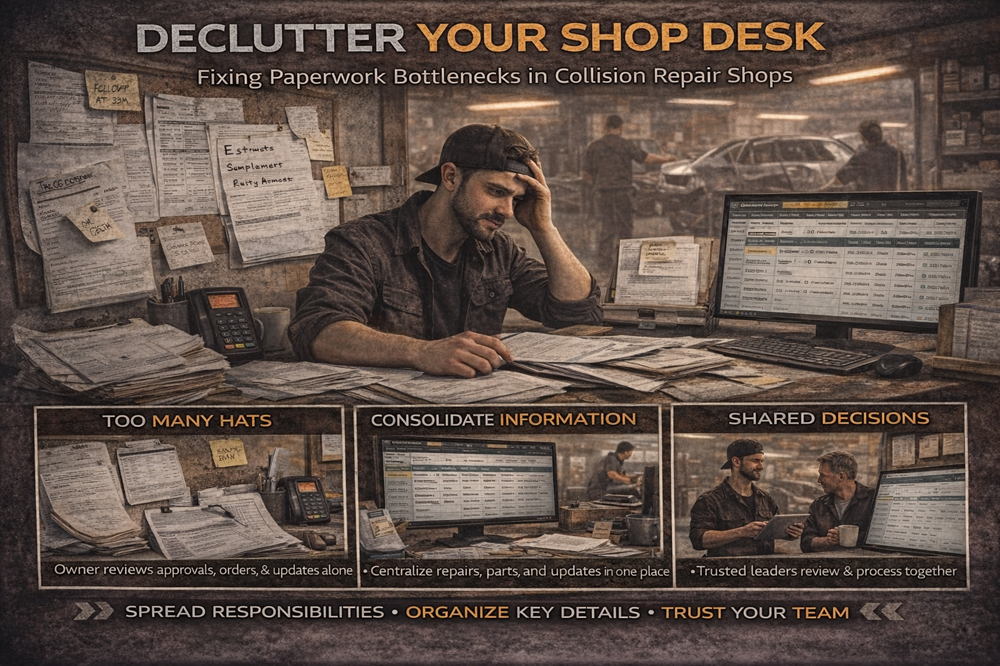
If your desk is always covered in paperwork, the problem isn’t a small desk.
When a small business starts getting busy, small tasks begin to pile up. Many of those tasks are indeed important, but not urgent enough to be handled immediately. Over time, they stack up, and before long, the owner’s desk becomes the place where everything waits. In collision repair shops, this problem tends to grow even faster. Even a small shop deals with a steady flow of estimates, supplements, insurance approvals, parts orders, and repair updates every day. If there is no clear system for handling all of it, even dull, unimportant paperwork slowly turns into a backlog that can directly drag down the entire business.
A messy desk usually means that too many decisions depend on one person.
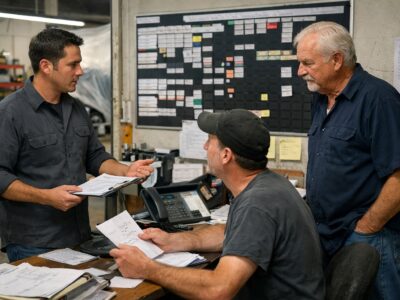
In many shops, the owner ends up as the final checkpoint for nearly everything. Parts orders wait for approval. Estimates wait for review. Invoices wait for a signature. When everything funnels through one person, progress has to slow, and the owner’s desk becomes the holding area for unfinished work.
One necessary solution is to involve someone else you trust in reviewing and handling those decisions. At first, this can feel uncomfortable. No one knows the shop the way you do, and a second decision maker will need time to learn how things work. In the beginning, that often means more questions and slower progress. But over time, this approach builds something valuable: more people in the shop who can confidently move work forward without waiting for the owner to approve every step.
Expanding leadership takes time, but the paperwork problem exists today.
Training new decision makers is a long-term solution. In the short term, many messy desks come from a different problem entirely: the shop’s information is scattered across too many places. Front desk staff tracks customer conversations, technicians update repair progress on a whiteboard on the repair floor, and parts orders are handled somewhere else entirely. All of those pieces eventually land on the owner’s desk because there is no single place where the information can come together naturally.
When information is scattered, everything rests on the owner.
This is where modern collision repair management systems can make a major difference. Instead of paperwork moving from desk to desk, job information lives in one shared system. Customer details, job status, insurance updates, parts orders, and staff assignments can all be viewed in one place. When the front office, the repair floor, and the back office are all working from the same synchronized information, many questions get answered before they ever reach the owner’s desk. Tasks that once required digging through piles of paperwork can often be handled with a quick look at the job record.
When decisions are shared across trusted leaders, and job information is organized in one place, most paperwork gets handled long before it becomes a pile. The owner is then free to focus on bigger decisions instead of sorting through stacks of approvals and documents.

A desk buried in paperwork usually means the shop is routing too many decisions through one person. How many collision shops are actually structured so work keeps moving even when the owner steps away?