
For many businesses, customer communication is limited to handling complaints, resolving difficult situations, or responding to feedback about products or services.
Because of this, communication in most industries focuses more on advertising than on explaining how work is actually done. Collision repair and body shops are very different. In this industry, the ability to clearly explain services and repair progress often determines whether a customer becomes a long-term supporter or just leaves a negative review.
Because of this difference, many technically skilled shop owners struggle with customer communication.
Explaining both the complex repairs being done, and the status of their specific vehicle in a way the average customer can understand is not easy, and there is often little training or guidance on how to do it well. However, there are practical ways to make this process more manageable.
One effective approach is to heavily limit the use of technical language.
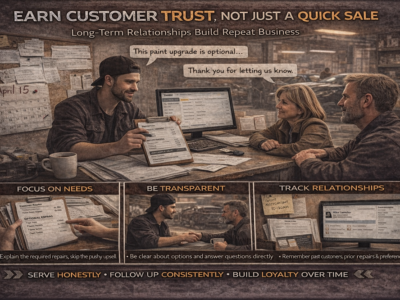
Instead of referring to specific parts such as the ‘chassis’, ‘undercarriage’, ‘suspension components’, or ‘body panels’, it is often better to describe the general area of the vehicle being repaired. This helps to prevent confusion and avoids making customers feel talked down to or overwhelmed. Another critical part of effective communication is providing regular updates, especially to customers who are stressed about being without their vehicle. Frequent updates help reassure customers that their repair is being handled, even if progress is temporarily stalled due to insurance approvals or parts delays. Simply knowing what stage the repair is in can greatly reduce frustration and prevent misunderstandings while building trust in your shop.
Of course, reaching out to every customer every day can quickly become time-consuming, something most small body shops cannot realistically manage without a dedicated front desk staff. This is where customer relationship management software designed specifically for body shops becomes valuable. Systems that consolidate vehicle information, repair status, notes, and photos allow staff to communicate quickly and accurately to customers without hunting for details. What could otherwise be an all-day scramble becomes a smooth, efficient process that benefits both your team and your customers through sharing information about what needs to be done.
By building trust through clear, easy-to-understand communication and consistent updates, body shops can reduce complaints, improve customer satisfaction, and grow their reputation.