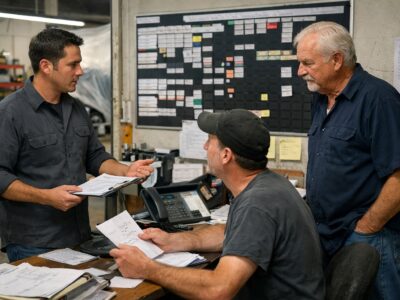

For most businesses, once profitability and stability are achieved, the next logical step is reinvestment.
Expanding inventory, hiring additional staff, increasing production capacity, or even opening a second location are common growth strategies.
In the collision repair and body shop industry, however, expansion is rarely this simple.
Growth often brings increased insurance requirements, certifications, licensing considerations, equipment costs, facility upgrades, piles of paperwork, and administrative complexity. Without careful planning, rapid expansion can strain operations and reduce profitability instead of increasing it. Reinvesting wisely begins with understanding return on investment (ROI). Not every improvement contributes equally to growth. Renovating the customer lounge or refreshing the front office may enhance appearance, but it is unlikely to increase the number of customers who walk through the front door. Purchasing new repair equipment may allow you to offer additional services—such as ADAS calibration or aluminum repair—but it may also require technician training, OEM certifications, and major workflow adjustments. Launching an advertising campaign could increase inbound inquiries, but if production capacity is already tight, it may create scheduling delays, longer cycle times, and result in more customer dissatisfaction rather than a growing bottom line.
These examples highlight an important principle: successful growth in a body shop requires groundwork before major investments are made.
Expansion should follow preparation, not precede it. If new equipment is coming, certifications and training should begin far before its arrival to avoid the shiny new equipment sitting around gathering dust. If a second location is being considered, leadership structure and staffing plans should be clearly defined before signing a lease to avoid friction within your team. If marketing efforts are increasing, repair processes must already be efficient enough to handle higher volume without sacrificing cycle time or quality.
One of the most overlooked, but most critical, foundations for sustainable growth is the software systems your team uses daily.
As volume increases, so do the demands on scheduling, customer communication, insurance documentation, accounting, and parts tracking. Manual systems that function adequately at a smaller scale often begin to break down under higher volume as minor mistakes pile up and free time to review and revise vanishes. Missed supplements, delayed or missed parts returns, poor visibility into job stages, and accounting inconsistencies become more common when processes are stretched by new upgrades.
With that in mind, investing in body shop–specific management software can be one of the most cost-effective early upgrades to support growth. Systems that centralize customer information (CRM), time tracking, inventory management, job status tracking, and payment processing provide visibility and consistency across the entire operation. With stronger systems in place, owners gain clearer data for decision-making and reduce the risk that expansion will harm rather than help the shop. Growth should strengthen a business, not destabilize it.
By focusing first on the bedrock of growth before the flash through training, workflow, staffing structure, and especially software, collision repair shop owners can position their businesses to scale efficiently and protect their bottom line’s growth as their business expands.