
The biggest barrier to improving operations in a small auto body or collision shop is the hidden transition cost.
Owners hesitate because they bear the responsibility of people who rely on their jobs and existing workflows. Without a clear payoff, change is risky. As a result, the same processes stay in place for years.
There is a risk-free way to start.
Every owner can take four steps: Record. Understand. Benchmark. Improve.
Start by recording.
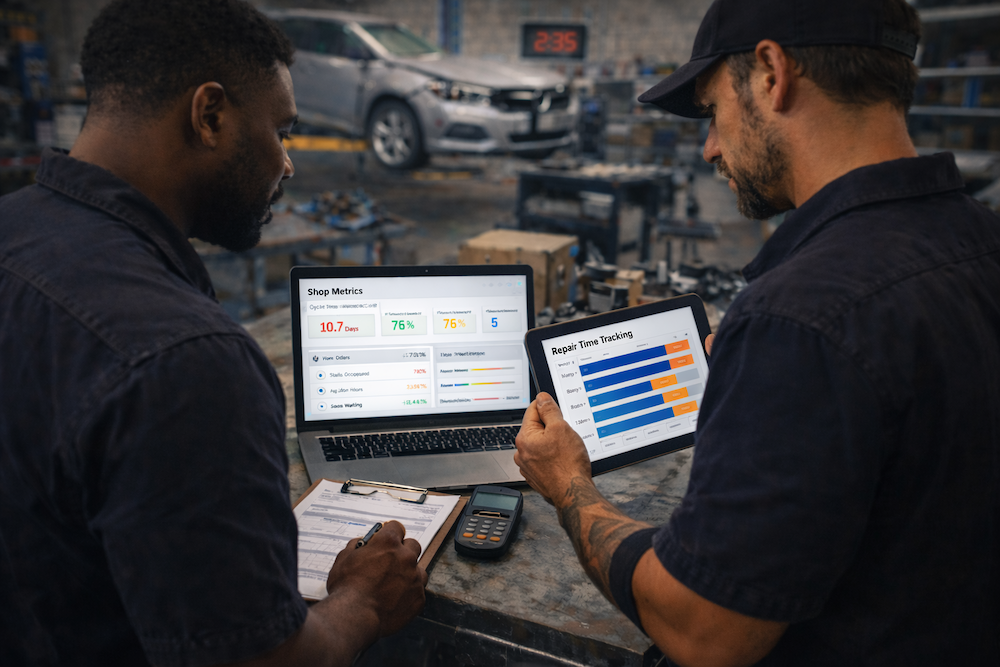
Use today’s tools to document what already happens in your shop. Track time, labor, and repair steps. In an auto body shop, time allocation drives cycle time, stall utilization, and delivery speed. Focus on data that shows where vehicles wait, where collision repairs slow down, and where labor hours expand. You cannot improve efficiency without something to compare against.
Then, understand the data.
Know your costs and profit for each repair order. When the numbers are connected, decisions become clearer. Free resources and AI tools can help identify which metrics matter beyond revenue and profit—and which ones apply to your shop.
Next, benchmark performance.
Identify the numbers that define how your shop operates. For example, if two technicians spend ten hours on a paint job for a single vehicle, that data raises a question about estimating, sequencing, or rework. As an owner, you already have an instinct for what good production and quality look like. Having fixed numbers confirms or challenges that instinct.
Finally, improve.
Improvement starts by identifying what already works in the shop and strengthening it. Once those foundations are stable, owners can make targeted adjustments with confidence and a clear expectation of results, without disrupting cash flow or daily operations. Auto body and collision shops have a short feedback loop on the floor. Changes show up quickly in cycle time, touch time, stall flow, and delivery dates. Data and daily floor observation provide feedback on the changes you make, turning decisions into steady, measurable progress.
Pro Tip: keep learning.
Owners operate on the front line of business growth. Staying effective requires continuous learning about tools, processes, and industry changes. You are not expected to apply everything you learn. Most information will not be relevant, but consistent exposure increases the odds of finding the hidden gem that solves a real bottleneck in your shop.
