Inefficiencies, lost revenue, and simple mistakes can significantly impact the bottom line of any business.
Even small errors add up over time, and every dollar lost to avoidable issues is a dollar that cannot be reinvested in the business. In today’s economy, ignoring these small losses can quietly create serious, growing problems down the road. In the fast-paced and competitive collision repair industry, these small daily cuts to profitability can be the difference between expanding to a new location and struggling to keep the doors open.
There are three common areas where body shops frequently lose money in small but consistent ways.
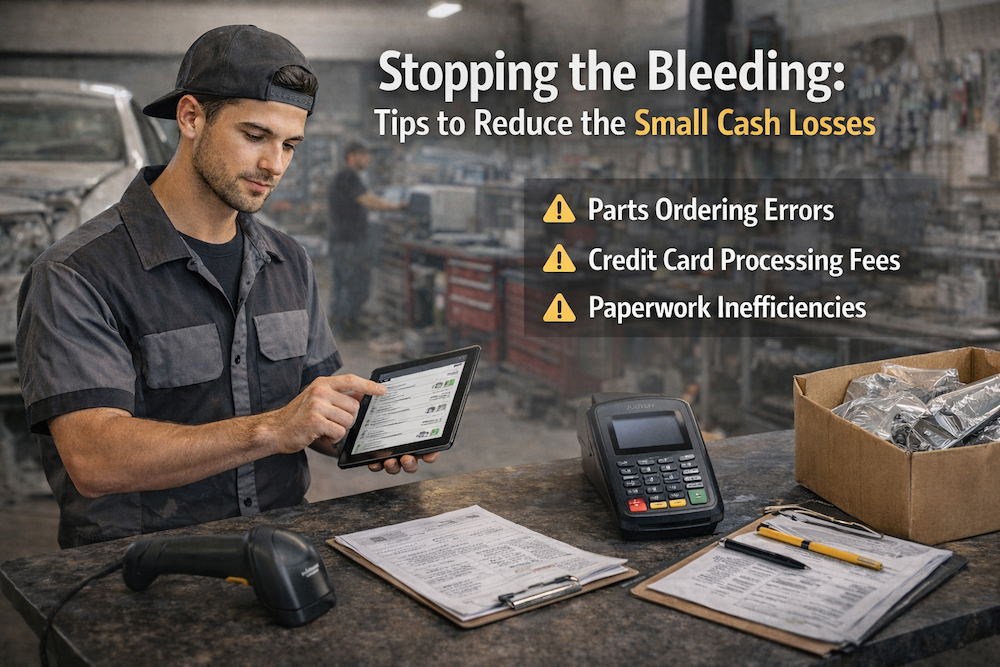
The first is on the repair floor, through parts ordering and inventory management issues. Managing dozens of parts across multiple jobs, from tracking arrivals, handling returns, and coordinating everything with repair schedules, can quickly become overwhelming for all staff. When parts are ordered incorrectly, not returned on time, or left unused, money is directly left sitting on the shop floor. The second area is at checkout. Credit card payments are now the norm, but they often come with processing fees of 3% or more. If these fees are not planned for properly, shops are either forced to absorb the cost or surprise customers with added charges at the register. Both outcomes directly hurt either your shop’s profitability or your customers’ trust. The third area is paperwork and its related physical costs. Printers, filing systems, lost documents, damaged papers, and the time spent managing written records all add unnecessary expense and frustration to daily operations.
These costs may seem small, but they compound quickly when multiplied across every job, every employee, every day.
None of these issues are catastrophic on their own, but together they create an ongoing financial drain. The good news is that these challenges can be addressed all at once by adopting body shop–specific management software. Digital documentation reduces or fully eliminates paper-related costs. Integrated payment systems allow shops to account for processing fees into the general cost of work, avoiding surprises for the shop or customer at checkout. Inventory tools designed for collision repair make it easier to track parts, manage returns, and reduce waste.
With the relatively low cost of modern, body shop-focused software, more and more shops are able to see that eliminating these small inefficiencies quickly results in significant improvements to the shop’s bottom line.