
Sustain your collision auto body shop with these two action plans
First, operate the shop as one organism.
Every person inside your shop is an organ with a single purpose: to keep the shop alive.
- Eliminate tribal knowledge: document important processes so the shop does not rely on memory or the owner.
- Keep all information in one place so procedures, decisions, repair records, and data are easy for the entire team to find.
- Share and teach skills: actively train all staff, including owners, to make knowledge and skill sets repeatable and transferable.
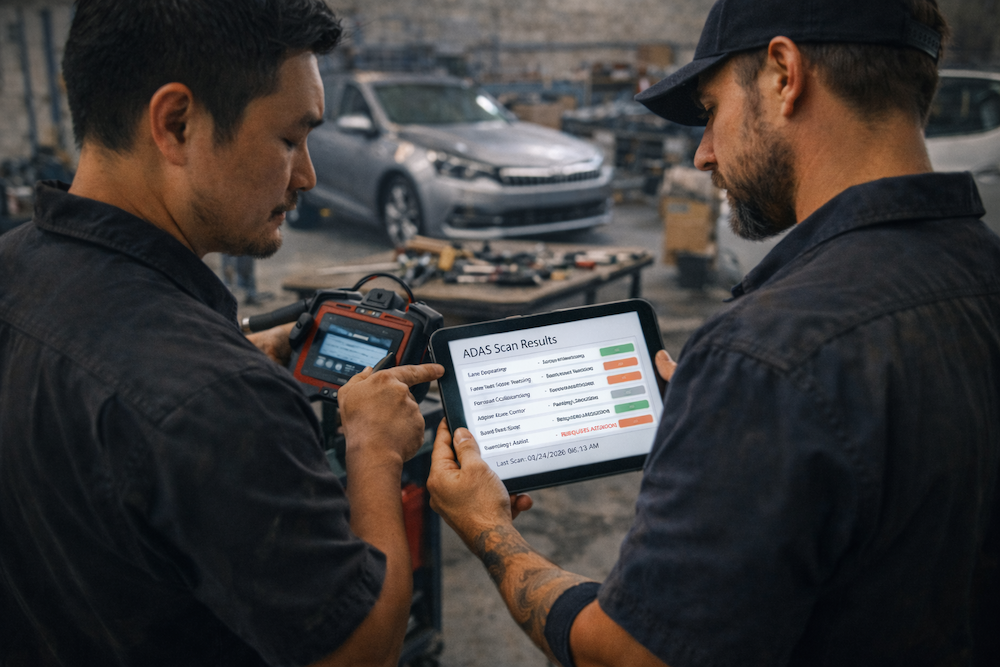
More and more vehicles are now equipped with ADAS (Advanced Driver Assistance Systems). Radars, sensors, and cameras are now built into exterior vehicle parts. For small collision repair shops, this makes repairs harder and more complex. This technology is advancing faster than labor skills can naturally keep up.
It is the gap in skills that causes the inefficiency. In the past, this skill gap between the employees was often covered by the strong craftsmanship of key technicians. From now on, the skill gaps will not only get larger, but the number of experienced technicians will either retire or become more rare in our industry.
It is understandable that people see it as a waste of time, and in the owner’s eyes, it is a waste of money. Why would an experienced technician spend their time on training when the same amount of time can be used to complete more jobs? If we look closely, the dilemma is the exact problem we want to solve in the first place.
Shops that successfully transform could achieve:
- Streamlined, stable, and predictable revenue.
- Reduce decision-maker stress because processes replace constant judgment calls.
- Hiring pressure is lower since training and knowledge are built internally, not dependent on specific candidates.
- The business gains the ability to scale during growth periods and remain resilient during a bad economy.
Second, learn how modern vehicle technology works so you can anticipate challenges.
- Follow tech and auto-related articles or news. You can be late or behind on the information, but you do not ignore it.
- Prepare integration of new procedures related to ADAS repair. Like include pre-scan, post-scan, and ADAS calibration as part of the repair SOP.
Recently, NVIDIA showcased its driving AI technology and announced plans to work with multiple car manufacturers. At the same time, this creates new competition for Tesla. If Tesla sees NVIDIA-powered vehicles as a threat, both companies are likely to push faster updates and improvements to stay ahead. This kind of competition leads to rapid changes in vehicle technology.
If this technology is widely adopted, it means vehicles will include even more advanced systems that collision repair shops must understand and work around. As vehicles become more complex and are built into different systems and components, the repair process needs to be adoptive and capable of changes. Repair quality is no longer judged solely by the look. Vehicles must be restored to full functional and safety performance.
Especially for shop owners, it is increasingly important to stay informed about upcoming automotive technologies and industry developments. Ignoring what is coming next can damage the business’s survivability. While the overall auto industry will not be influenced in the short term. But the shift may introduce new roles or baseline skill requirements within collision repair operations, which one can prepare early. Understanding these systems is becoming a requirement for working on modern vehicles at all.
