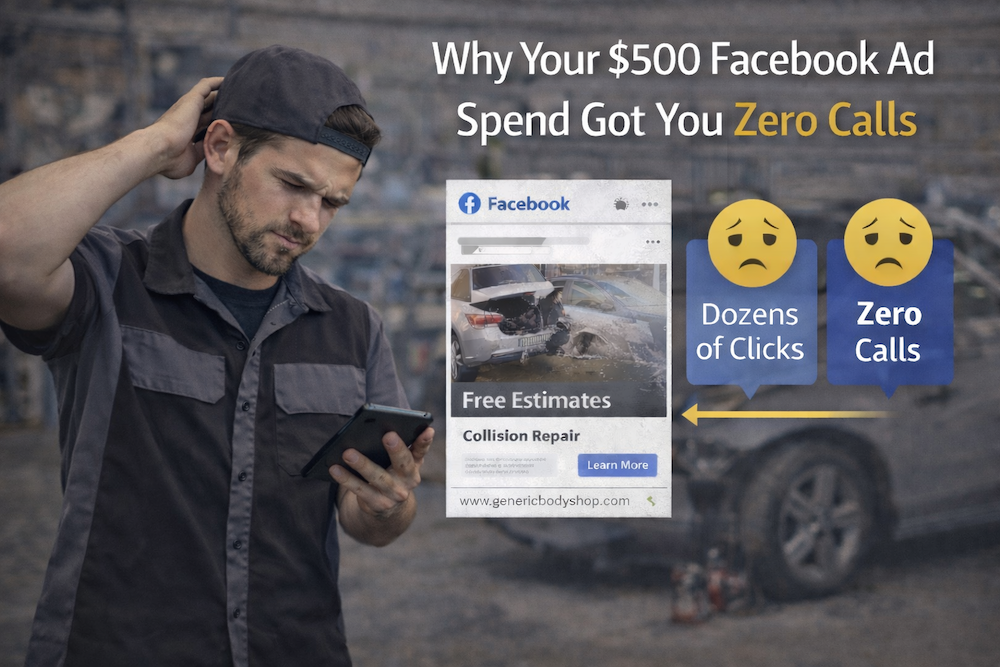
You can spend $500 on Facebook, get dozens of clicks, and still get zero calls because the ad did its job, but the system behind it did not.
People click when they are curious, then they bounce when they cannot tell what happens next, how fast you can help, or whether you handle other insurance and ADAS issues cleanly. In collision repair, urgency is real, but trust is fragile.
How to advertise on Facebook?
The common practice is treating Meta ads like a billboard: broad radius, generic promise, and a homepage link. The reality is, most people in a 25-mile circle do not need a body shop today, and “Free Estimates” does not separate you because everyone says it.
When customers land on a general website, they have to hunt for direction, and that is where intent dies. The customer is also cross-checking reputation and reviews as part of choosing a body shop, so the ad has to match what they will validate next.
Use four decision checkpoints and build your ad around them:
-
Trigger: aim at active need, not general awareness (accident, damage, claim started, tow, drivable but unsafe).
-
Proof: show real work and real constraints: teardown finds, parts delays, insurer approvals, ADAS calibrations, final wash and delivery.
-
Offer: one specific next step, like “photo estimate review today” or “insurance supplement handled in-house.”
-
Path: a single landing page with one action, call or form, not a menu of pages.
Retargeting is the second half of the system. Many people will not call on the first click, so you follow up with a different message that reduces friction and answers the obvious question: Can you start fixing now, and will you handle the insurance process?
Meta Pixel is a tracking device for website activity and to optimize your advertising performance. And it is the standard way to measure those site visits and re-serve ads to people who already showed intent.
What to do now?
This week, pick one job type you want more of for your business. And build one straight path for that customer to reach you.
-
Pick one promise. Examples: “Same-day estimate,” “Photo estimate review,” or “We handle insurance supplements.” Choose the one your shop can reliably deliver.
Make one simple page for that promise. A single page with:
-
Use the promise as the headline,
-
Provide 3 before/after photos
-
2 short reviews
-
big phone number
-
One form that asks for name, phone, car, and 2 photos. No shop history, no extra menus.
Run one ad that matches the promise. Use one short video or a before/after clip. The ad text should say the same promise, and the button should go to that one page. Do not send people to your homepage.
How to know if it worked:
Track only two numbers for 7 days: calls/texts from the page and estimated appointments set.
If those stay at zero, do not spend more money yet. Change one thing only: either the promise (what you’re offering) or the page (make the call/form impossible to miss), then run it again for another week.