
By: Arthur Roseberry
For most businesses, professional relationships are built around local suppliers, distributors, and major clients. These long-term partnerships often lead to better pricing, improved flexibility, and mutual trust when problems arise.
In collision repair, however, business relationships for small independent shops are far more uneven.
Insurers may delay or challenge payments, parts suppliers prioritize volume accounts, and fleet or commercial clients can leverage their size to pressure your pricing. Understanding how to reduce risk and increase your shop’s leverage within these relationships can determine whether your business can build stable long term success or remain helpless to industry forces completely outside of your control.
The first step is recognizing your shop’s position in the market.
Independent collision repair facilities are often negotiating with organizations significantly larger than themselves. A fleet account may threaten to move vehicles elsewhere over rate disputes. A parts supplier may prioritize larger MSOs when inventory is tight. Insurance carriers focus primarily on cost control and cycle time performance rather than loyalty to a single location. Competing purely on volume is unrealistic, and relying solely on quality is rarely enough to differentiate yourself in these relationships.
Where smaller shops can stand out is in operational consistency and ease of interaction.
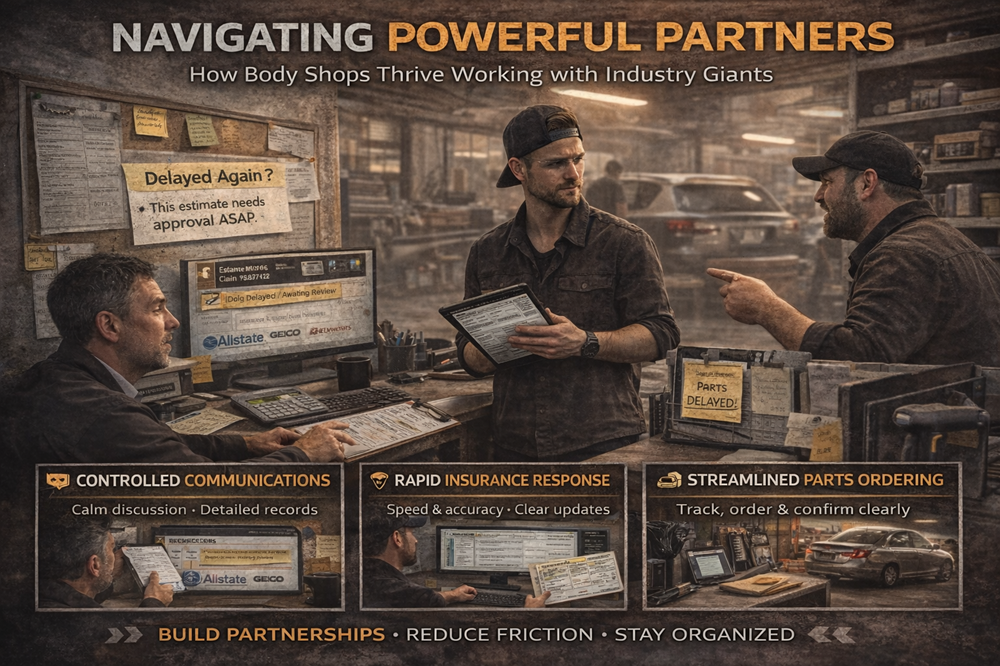
Large organizations value reliability and predictability. A major insurance company will not personally appreciate the craftsmanship of a refinish job, but they will notice clean documentation, fast supplement turnaround, and consistent communication throughout the job. A parts supplier may not even notice your weekly order size, but they will recognize clear ordering, minimal returns caused by internal errors, and rapid follow-up. A fleet manager will not see the extra hours invested in a critical rush repair unless updates are structured, frequent, and proactive.
Reducing friction in every interaction creates your leverage.
When your shop is known for accurate estimates, organized documentation, quick responses, and minimal administrative back and forth, you become easier to work with than competitors. In high-volume corporate environments, ease can often outweigh size.
The challenge, of course, is the administrative demand this approach creates.
Rapid insurer responses, detailed photo uploads, structured job updates, and accurate parts ordering require coordination. Without systems, this workload can overwhelm a small team.
This is where modern, bodyshop-specific management software becomes a strategic advantage.
Centralized job tracking, integrated photo documentation, streamlined estimate to invoice workflows, and organized CRM tools allow your shop to respond quickly and consistently. Instead of chasing paperwork and status updates, your team can deliver clear, professional communication as a standard process. In an industry where many business relationships are massively one-sided, operational discipline, speed, and reliability will set your shop apart.