By: Arthur Roseberry
For any team to accomplish a meaningful goal, it must be more than just ordered or directed; it must be led.
This principle applies to running a business just as much as in sports, games, or any other part of life. Team members who feel unmotivated, disconnected, or replaceable never perform at their highest level and can spread those bad vibes throughout an entire business. In contrast, a unified team with clear direction and strong leadership will consistently work harder, improve faster, and take greater pride in the results they deliver. In a collision repair or body shop, building that kind of team can be especially challenging. Unlike office environments where employees work side by side throughout the day, body shop staff are often divided across the repair floor, refinish area, estimating specialists, and front office. Their responsibilities differ, their workflows rarely overlap, and their daily pressures are not the same. Without intentional leadership, this separation can lead to communication breakdowns, finger-pointing between divisions, and result in a complete lack of shared purpose. Over time, that disconnect directly impacts cycle time, customer satisfaction, and eventually, shop profitability.
Effective leadership begins at the top.
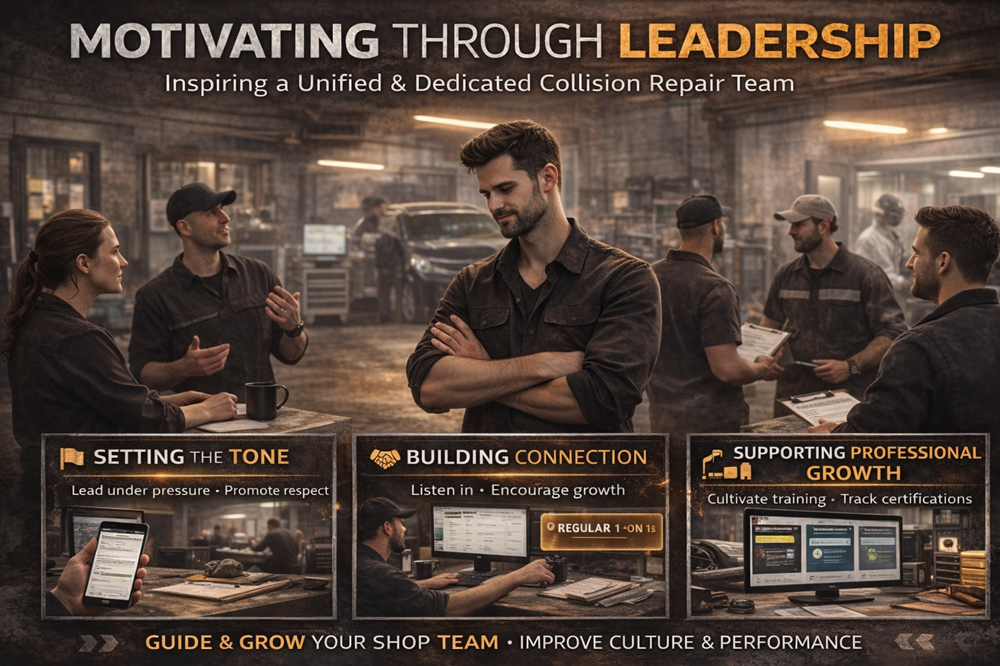
The tone set by ownership and management shapes the culture of the entire shop. If disagreements between leaders are handled publicly, emotionally, or even physically, employees will assume that behavior is acceptable to handle their own issues within the shop. If leadership communicates clearly, remains composed under pressure, and treats others with respect, that standard becomes the expectation, rather than the ideal, across all departments. Once leadership sets the example, the next ongoing responsibility is communication. Employees need to feel heard, supported, and valued. Regular check-ins help uncover frustrations before they escalate into larger conflicts. Encouraging professional growth, whether through certifications, training programs, or new responsibilities, reinforces that each team member has a future within the shop and makes clear that their work is seen and valued. When employees see a path forward, they are more likely to invest effort into improving their skills and supporting the broader team.
As your shop grows, however, maintaining this level of leadership becomes more complex.
It becomes difficult to remember every development conversation, certification deadline, performance concern, or career goal of your entire team. When follow-up is inconsistent, or commitments are forgotten, employees will feel overlooked and expendable rather than supported and valued, undoing any positive effects the main conversation had. This is where structured systems can help strengthen leadership.
Modern body shop management software can track much more than payroll and time cards. It can help monitor technician certifications, training progress, production metrics, and workload distribution.
Organized records of employee reviews, task records, and even development plans allow leadership to follow through consistently and accurately. While software does not replace personal leadership, it supports it by keeping important information about your team accessible and organized. By combining strong example setting, consistent communication, and structured bodyshop management tools, you create a culture where employees feel guided and led rather than managed and ordered. In a collision repair shop environment where coordination across departments is essential, that kind of leadership leads to smoother operations, stronger morale, and a stronger bottom line. Over time, a well-led team will become one of your shop’s most valuable competitive advantages.