
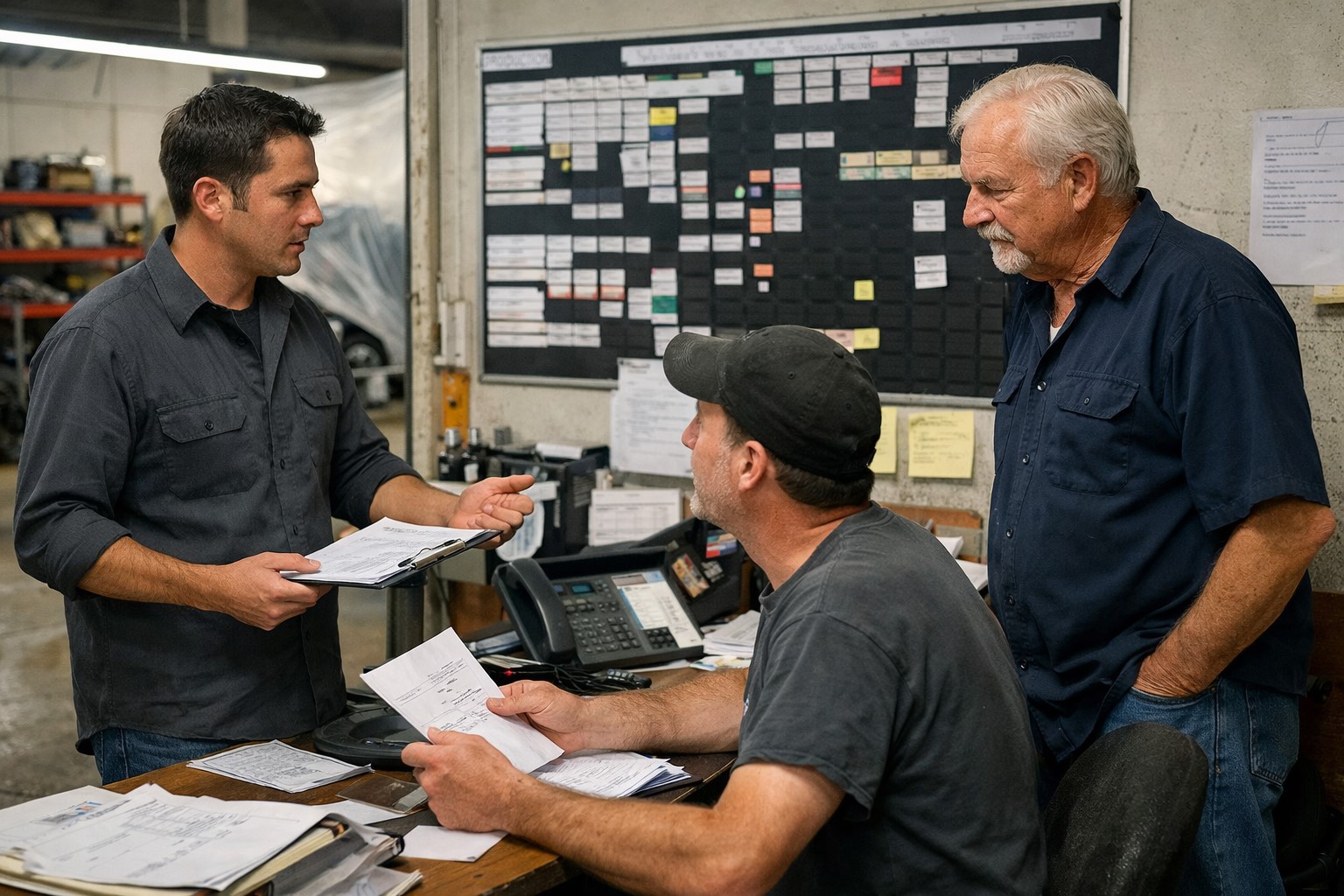
Many family transitions in a collision repair shop stall for the same reason: the founder never actually leaves the decision loop. The title changes, the next generation becomes the owner, but employees, vendors, and insurers still default to the person who ran the collision repair shop for twenty years. Production questions, supplier issues, and insurer conversations quietly route back to the founder. From the outside, succession appears complete. Inside the collision repair shop, authority never moved.
This usually develops without open conflict. Founders stay involved because the business matters to them, and stepping away feels unnatural after decades of daily control. The new owner may keep deferring out of habit, respect, or uncertainty. Over time, the collision repair shop starts operating with two centers of authority, and employees lose clarity on where final decisions actually sit.
That confusion shows up quickly in daily operations. Technicians learn which person to ask when they want a different answer. Vendors keep calling the founder because that relationship feels safer. Insurer conversations drift back to the previous owner because that is who has always handled the harder negotiations. Even with the title, the successor struggles to build credibility because major decisions still trace back to the founder.
A transition only works when the withdrawal is structured. A defined timeline gives the business visible operating rules. Production control, vendor communication, and insurer negotiations should move to the new owner according to specific milestones so employees can see where authority now sits.
Several boundaries make that shift real:
-
Set a date when the founder stops attending production meetings.
-
Route all supplier and insurance calls through the new owner.
-
Establish a point when the founder becomes available only by appointment.
-
Redirect employee questions back to the new owner every time.
Consistency is what stabilizes the transition. If an employee asks the previous owner to override a decision, the answer should be a referral back to the successor. When a vendor reaches out to the old contact, the response should reinforce who now leads the collision repair shop.
Authority does not move automatically when ownership changes. It transfers when the previous leader repeatedly steps aside, and when that shift becomes visible to employees, vendors, and insurers. Letting go is rarely one moment. It is a sequence of deliberate decisions that moves authority to the next operator.



One of the fastest ways to test whether authority has actually moved is simple: when a vendor, insurer, or employee has a problem, who do they contact first?