
By: Arthur Roseberry
For any business to succeed, there must be a steady stream of customers coming through the door.
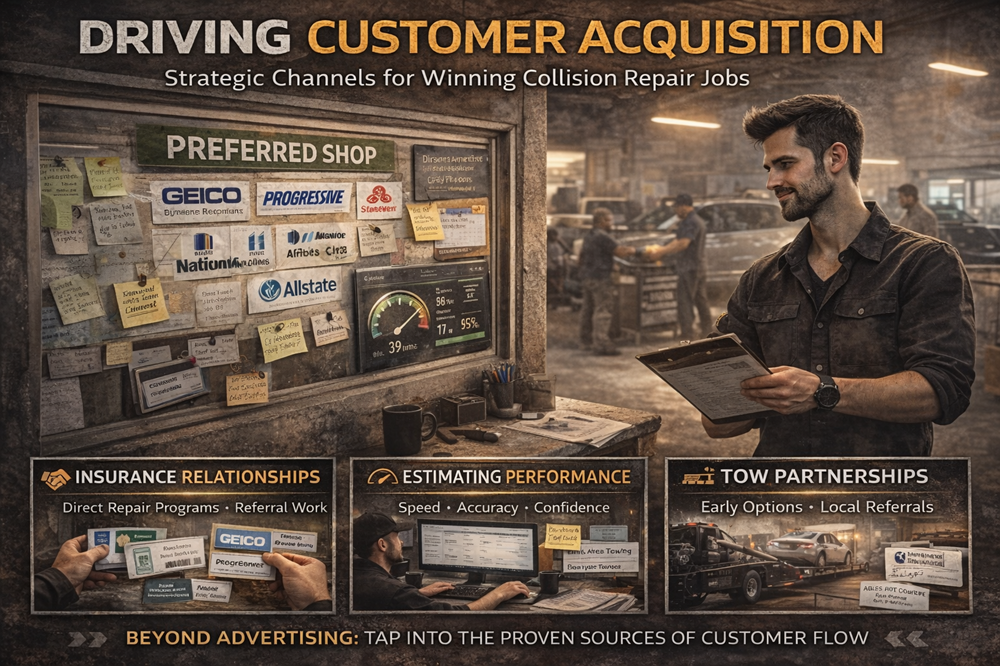
In most industries, that goal is pursued through targeted advertising, a strong online presence, and/or partnering with influencers. Collision repair and body shops, however, can benefit far more from using a very different customer acquisition model. Insurance relationships, estimating speed and accuracy, and tow provider interactions play a far greater role in getting your shop in front of potential customers than traditional marketing alone. Shops that understand how to maximize these industry-specific channels have a significant advantage in bringing customers through the front door.
The first and most critical factor in being considered by potential customers is insurance alignment.
If you are not properly positioned with the insurers operating in your local area, many potential clients will never seriously consider your shop, since they simply cannot have the repair costs covered by working with you. Participation in Direct Repair Programs (DRPs) and maintaining strong working relationships with insurance carriers significantly increases visibility. While the DRP application and compliance process can be time-consuming and operationally demanding, it remains one of the most powerful ways to ensure a consistent flow of referred work. Even outside of formal DRP participation, clearly communicating which insurers you regularly work with removes uncertainty for potential customers at a stressful time for them.
The next key driver of customer acquisition is your estimating process. Estimating is not just a technical exercise; it is a sales moment.
The speed of response, accuracy of the assessment, and clarity of communication all influence whether a vehicle owner chooses your shop. A delayed estimate creates doubt. A confusing estimate erodes trust. A fast, accurate, and clearly explained estimate builds confidence before you have even brought the vehicle into a bay. When customers feel informed and understand both the repair process and their insurance coverage, they are far more likely to move forward with you, both for this repair and any in the future.
Tow truck relationships are another often overlooked channel. In many collision situations, the first industry professional a customer interacts with is a tow operator.
While laws vary by state and improper referral arrangements can create legal exposure, tow companies are typically permitted to provide customers with neutral information such as local repair options and accepted insurance carriers. Ensuring that your shop is known, professionally regarded, and accurately represented on those lists increases the likelihood that your name is presented early in the customer’s decision process. In urgent, stressful situations, ensuring your shop is visible early matters.
In collision repair, customer acquisition is not just about visibility; it is about operational readiness and industry alignment.
It is important to recognize that traditional, broad marketing alone rarely keeps a collision repair shop full. Customer acquisition in this industry is tied closely to operational credibility, insurance participation, estimator performance, and local professional relationships, which often greatly outweigh the effects of generic advertising strategies.
Just as important as bringing customers in is having the systems to handle them efficiently.
An influx of new jobs can quickly overwhelm a shop that relies on outdated or fragmented systems. Insurance documentation, supplements, photo uploads, parts tracking, and customer updates all require coordination. Without specialized management software designed for collision repair workflows, growth will quickly become chaotic rather than profitable.
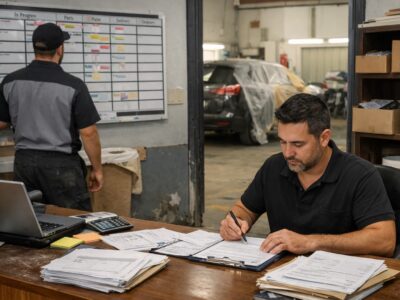

Marketing doesn’t fill bays in collision the way insurance alignment and estimating speed do. How many shops are still investing more in ads than in tightening the systems that actually control their car count?