
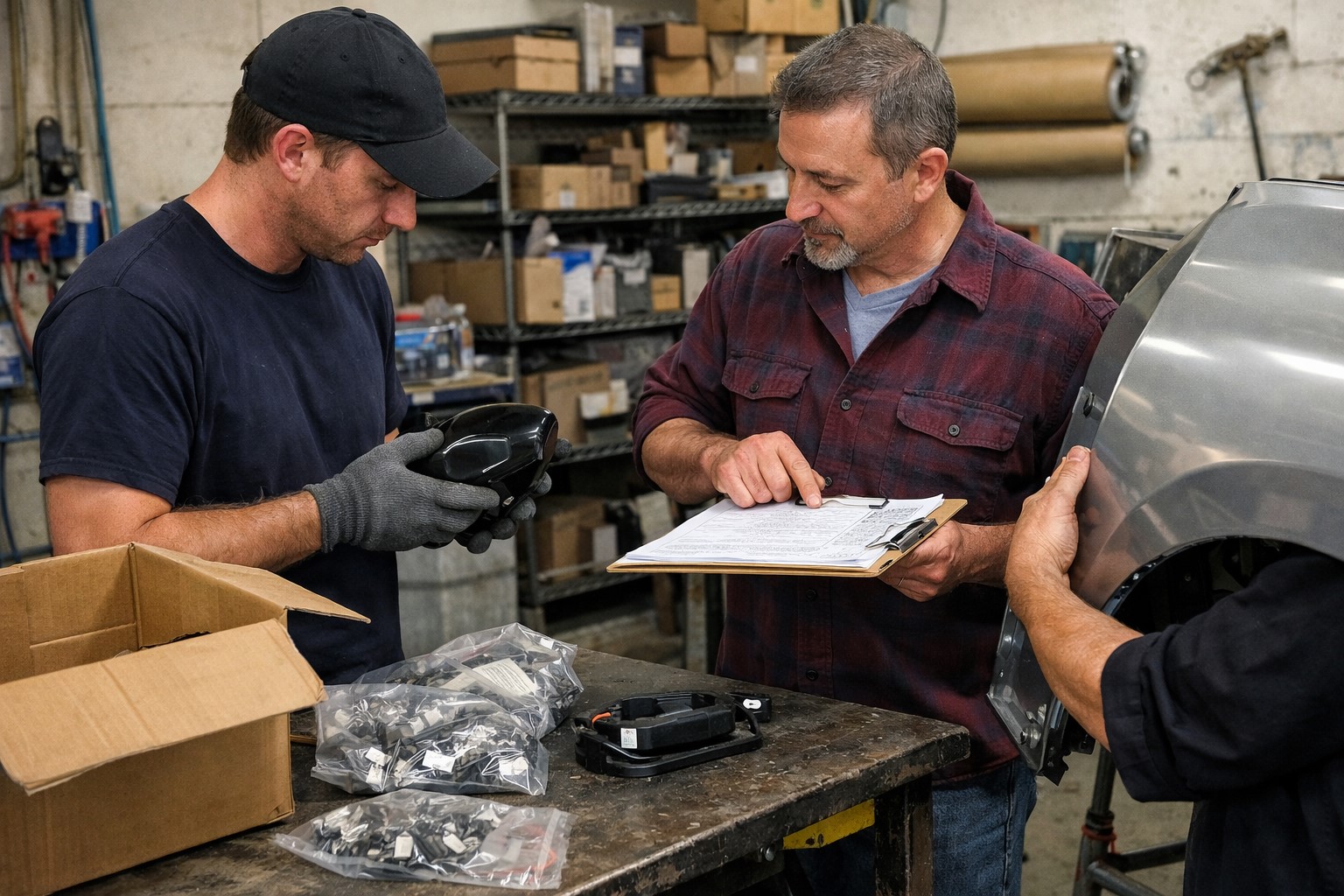
A mirror box lands, the quarter panel is on the rack, and the repair order looks ready to move. The technician pulls the vehicle into the stall and begins fit-up. Within minutes, the job collapses. The mirror is missing the sensor bracket, the hardware bag is short retainers, and the replacement panel has shipping damage along the edge. Production stops while the estimator calls the vendor, and the technician’s scheduled block disappears.
This situation is common in modern collision repair because parts supply chains remain uneven after the pandemic. Deliveries arrive late, components ship separately, and Advanced Driver Assistance Systems (ADAS) related parts often include hidden subcomponents that are easy to miss during intake. What looks like a simple mirror or bumper cover can actually be a bundle of brackets, sensors, and mounting hardware that must all be present before work can begin.
That is why a parts arrival check is not just a receiving task. It is a production control point.
Many shops confirm only that the primary replacement part arrived. The box is scanned, the invoice is matched, and the part goes to staging. The problem appears later when the vehicle enters the stall, and the technician discovers the repair cannot proceed. At that momen,t the job has already consumed floor space, technician attention, and administrative time.
A stalled repair order rarely stalls alone. The technician shifts to another vehicle, the schedule reshuffles, and the production board becomes less predictable. Touch time drops while cycle time expands. What began as a missing clip or damaged flange turns into a full day of lost productivity.
Before a vehicle moves from parts staging into production, the shop should confirm four practical checkpoints:
-
The part number, side, and application match the repair order and the vehicle.
-
The box has been opened and the panel inspected for cracks, bent flanges, broken tabs, or shipping damage.
-
Clips, retainers, brackets, seals, and hardware bags are present and complete.
-
Sensors, harness connections, and any calibration-related components for ADAS are accounted for before fit-up begins.
The rule is straightforward. A job should not start because a large part has arrived. It should start because the repair is buildable.
For independent collision repair shops operating with tight staffing and limited stall space, protecting technician time matters more than ever. A consistent parts arrival check prevents false starts, preserves touch time, and keeps the production board aligned with real progress instead of assumptions.

What burns more technician time in your collision repair shop right now: true backorders, or jobs that looked ready but were not actually buildable?